

Partner - Business Tools


The landscape industry is massive. It accounts for nearly $200 billion in annual revenue, 1.4 million workers across nearly 700,000 firms and is projected for steady growth through 2030 (1). Yet unlike other similarly positioned industries, landscaping hasn’t attracted venture capital or significant technological innovation. The issue isn’t that landscaping is unattractive; it’s that investors haven’t yet identified a clear, scalable path to productivity gains.
Part of the challenge goes beyond landscaping itself. The entire construction sector faces a well-documented productivity paradox (2). Output per worker has stagnated or declined for decades, even as other sectors and the U.S. economy as a whole have become more efficient. In industries with labor constraints and slowed productivity, investment goes toward solutions that unlock efficiency. In industries where those bottlenecks are unclear, funding lags.
Construction and related industries’ productivity paradox isn't for lack of demand. Spending in the U.S. has hit record levels thanks in large part to infrastructure bills. The sector’s main concern is an existing labor shortage, even in the face of rising wages. This constraint is structural rather than cyclical and exacerbates firms’ ability to increase output per worker. The result is a self-perpetuating cycle: low productivity limits investment, limited investment slows innovation, and slow innovation further hamstrings productivity.
It’s clear that the landscaping industry must innovate its way out of the productivity paradox. It cannot simply hire more workers. Instead, it must identify ways to increase worker throughput. This three-part whitepaper series will examine landscaping’s predicament, highlight avenues for future investments, and explain how the industry can modernize, today.
(1) Landscaping Services in the US Industry Analysis, 2025
(2) Why Has Productivity in the US Construction Industry Stagnated? | Goldman Sachs
Part 1: Capital flows to similar industries, but not landscaping
Part 2: The productivity paradox holds back construction and related industries
Part 3: Hiring more workers won’t solve the problem
At first glance, landscaping looks similar to other industries that have attracted significant venture funding, such as logistics and freight, and HVAC and plumbing. Each of these industries is also large, fragmented, operationally complex and historically reliant on manual workflows. Yet investors have flooded those industries with capital for a specific reason. Investors weren’t betting on the industries themselves. They were betting that software could open high-impact bottlenecks at scale.
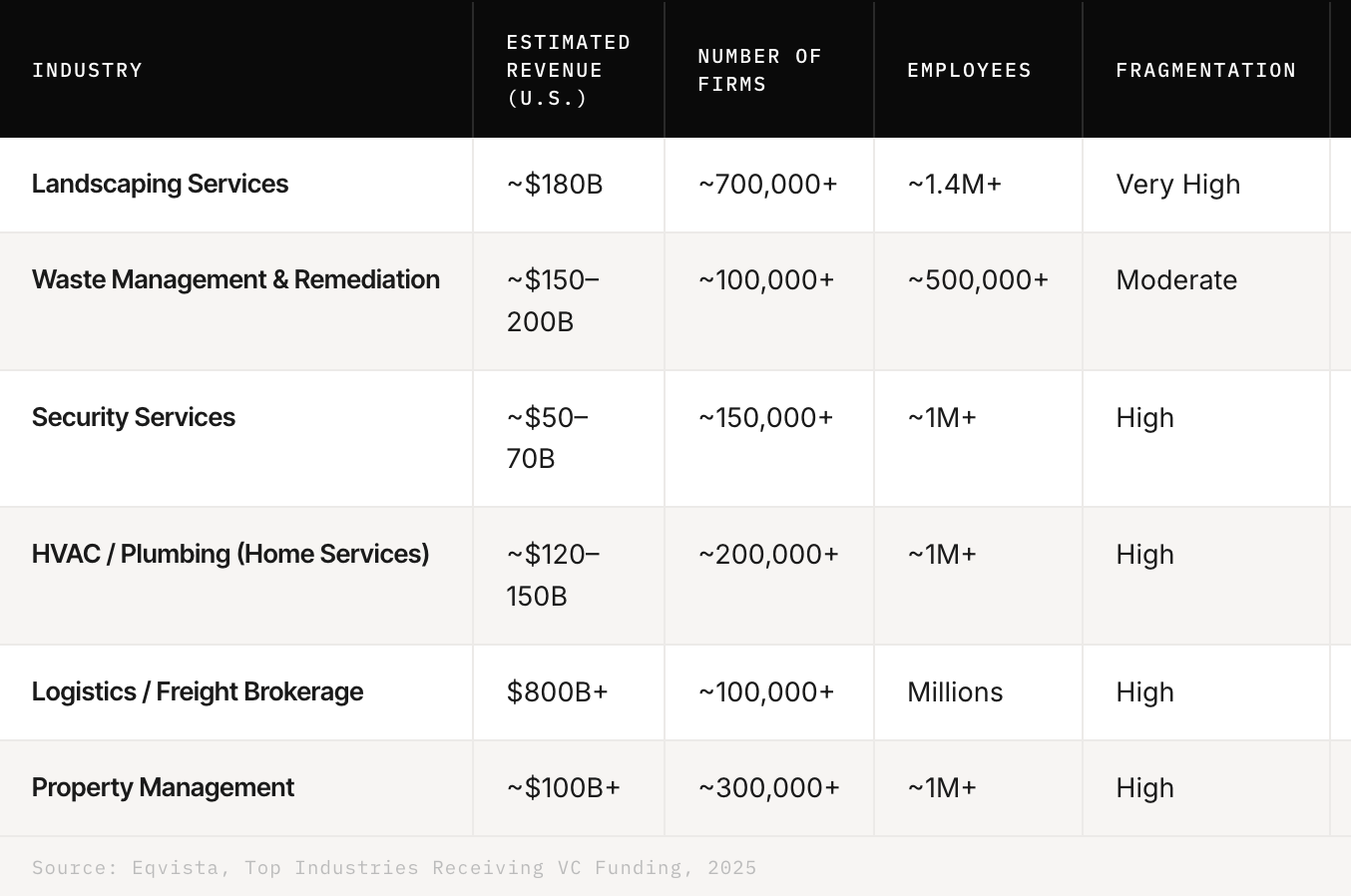
The logistics and freight industry offers a good example of investments unlocking bottlenecks. Despite comprising millions of employees at more than 100,000 companies, the industry has attracted billions in funding over the last decade (4). VCs targeted real-time visibility, manual pricing and fragmented communication that frustrated many firms. The solution? Software platforms that centralized and automated these functions. The story is largely the same for other industries structured similarly to landscaping and freight and logistics (5).
(3) Top Industries/ Sectors That Received VC Funding (2025) | Eqvista
(4) Why investors are pulling back on logistics start-ups | McKinsey
(5) New Funding Rounds in waste management services | VentureRadar
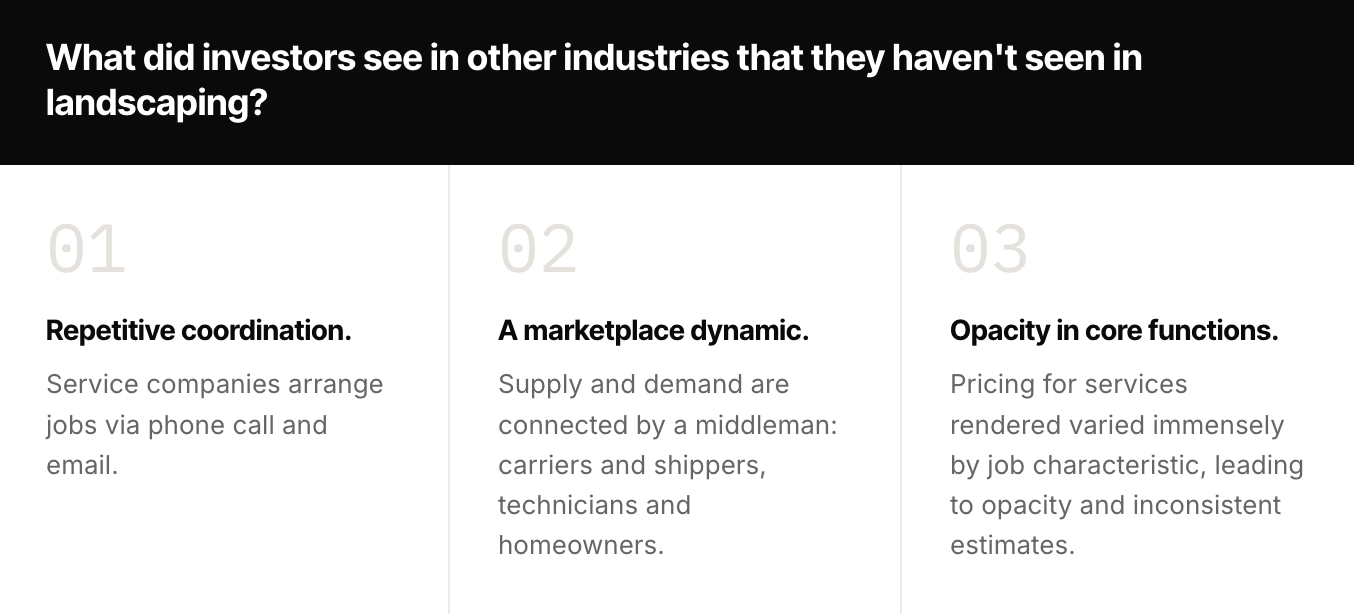
These bottlenecks happen often and exist within complicated decision loops. Software platforms are ideally suited for automating these high-frequency activities and standardizing workflows that were once more haphazard and analog.
Software platforms offer an additional benefit in these instances. As automated systems scale, they generate reams of data. Companies can use this operational data to continue improving efficiency and expanding capacity. The result of venture capital is then twofold. Firms realize near-term ROI as well as long-term leverage from the data.
Software platforms create efficiencies by automating repeatable, often standardized inputs. But landscaping’s variability means that the underlying workflows don’t always repeat themselves.
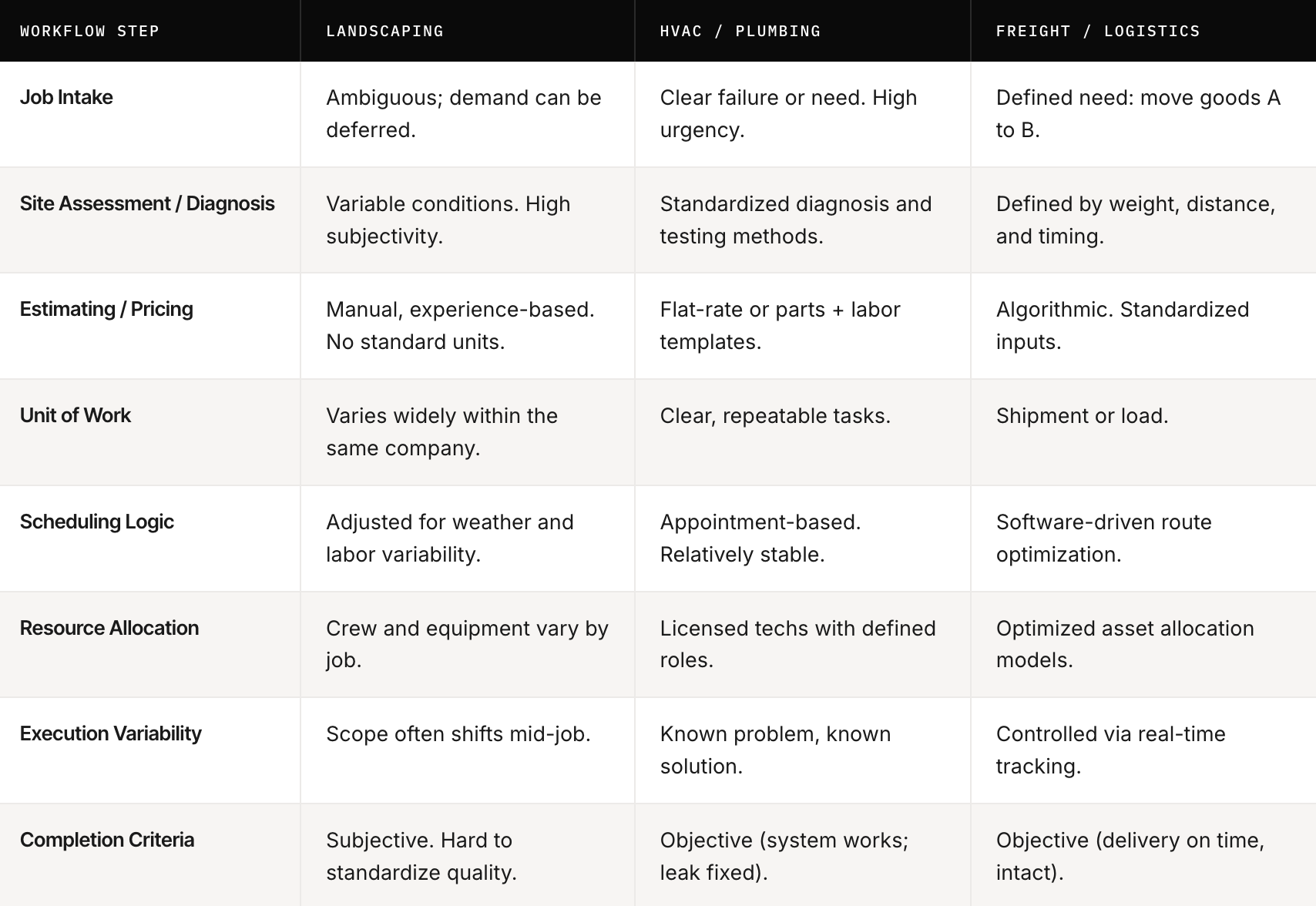
Despite structural similarities with other VC-infused industries, landscaping’s underlying work is very different. HVAC and logistics tasks break down into clearly defined and repeatable scopes, which makes pricing easier. Landscaping, on the other hand, isn’t a monolith.
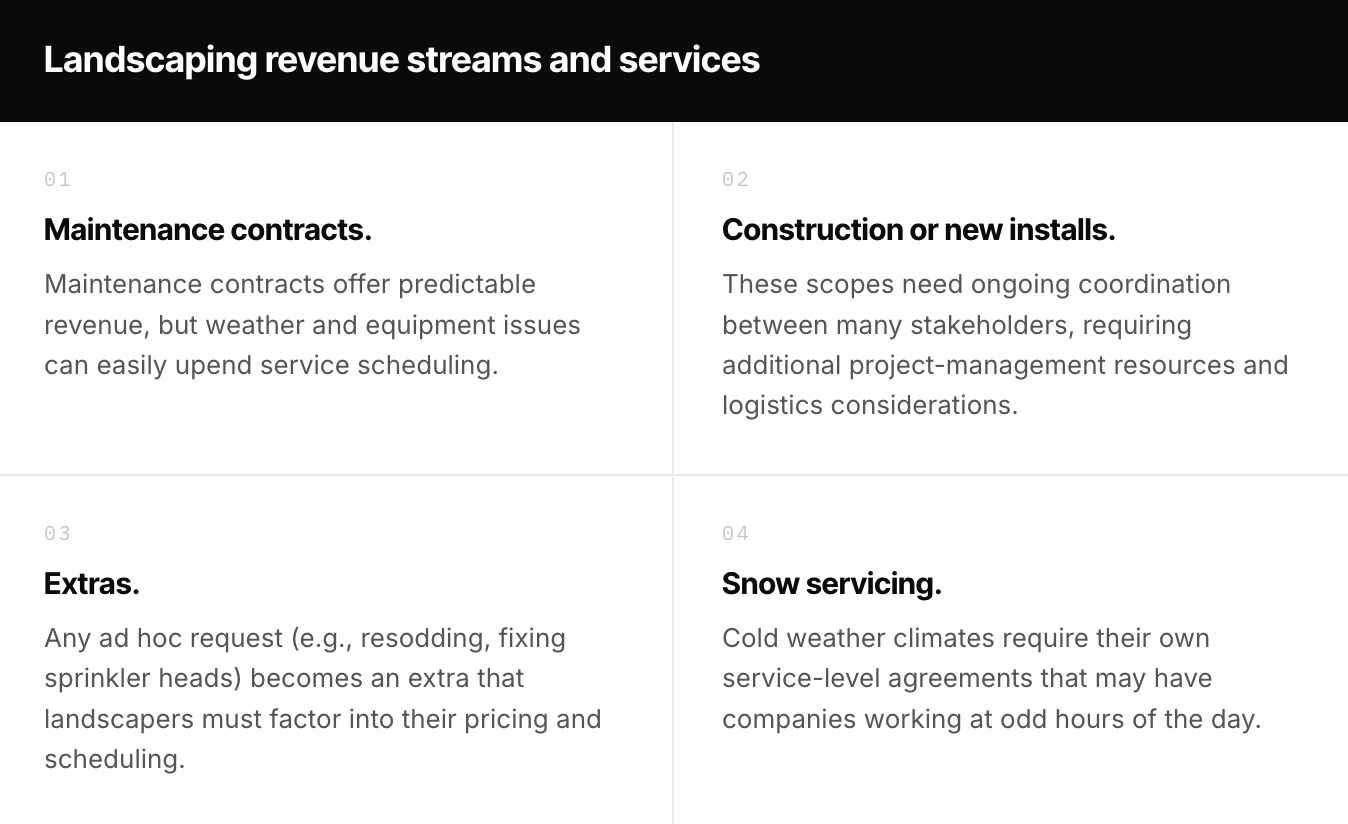
The industry mixes different business models. Residential maintenance is recurring and route-based. Commercial work involves heavy coordination with tighter expectations. Design/build projects are highly variable and often bespoke. Even within a single company, estimating, scheduling, and executing a job can look completely different depending on the project.
In the HVAC and plumbing industry, a furnace breaks and needs repair, or a new building needs water lines. Jobs tend to resolve into fairly discrete tasks with known parts, prices, and predictable workflows. Landscaping, on the other hand, often lacks a consistent unit of work, depends heavily on human judgment, and varies widely based on site conditions, customer preferences, and even weather.
Landscaping companies must also contend with unique service offerings. Many commercial firms have up to four revenue streams, each with its own requirements. Running each of these service offerings is akin to running a new business, because of how different those operational requirements are.
Between the number of firms, the lack of standardization, and the parallel but unique revenue streams, the “missing operational layer” isn’t just a theory—it’s a direct result of how messy and variable the underlying work actually is.
Operational complexity alone doesn’t explain the gap in venture funding. A larger phenomenon that affects the entire construction sector keeps capital at bay: the productivity paradox.
For decades, construction sector productivity has remained flat or declined, even while the broader U.S. economy has enjoyed consistent productivity gains. The paradox highlights how construction and related industries have failed to turn high demand into output efficiencies.
The issue isn't demand. Boosted by sweeping infrastructure bills, U.S. construction spending continues to approach record levels (6). The sector has struggled to turn this heavy investment into higher output per worker. Landscaping, as part of this larger sector, inherits the same challenges.
Construction also faces structural constraints. It is difficult to standardize and centralize decisionmaking for fragmented and project-based workflows. Unlike the HVAC or shipping and freight industries, construction does not present an operational layer that software might automate, optimize and scale.
In addition to its complex structure, the sector is also not as digitized as other industrial sectors. Many firms still rely on spreadsheets, phone calls and even paper-based communications. The tools that firms deploy tend to help with administrative activities rather than high-frequency tasks that drive revenue, like pricing and resource allocation.
All of these factors are major headwinds preventing construction-related industries from realizing additional productivity gains. Industry groups have long championed upskilling and revamped worker training to bridge the productivity gap. These efforts, though necessary, will not be sufficient on their own to pull industries like landscaping out of this paradox.
Upskilling and training assume that productivity stagnation comes from a mismatch between worker ability and task. Instead, the issue is more fundamental. The industry and systems in which workers operate hasn’t evolved enough to enable meaningful output gains per worker. Even the most efficient landscapers will be constrained by manual estimating or spreadsheet-based project coordination. Unlocking new productivity requires changing landscaping at a systemic level.
(6) US Census Bureau, Monthly Construction Spending, March 2026
Landscaping—and the entire construction sector’s—labor issues extend beyond skills alone. And the constraint isn’t cyclical, as other industries experience. Job openings outpace hiring despite rising wages. But fewer younger workers are entering the trades even as older employees retire, leaving the sector with a structural and ongoing labor problem. Though industry think tanks and publications recommend upskilling workers, the current labor dynamic makes it clear that the sector will need more than more headcount and training.
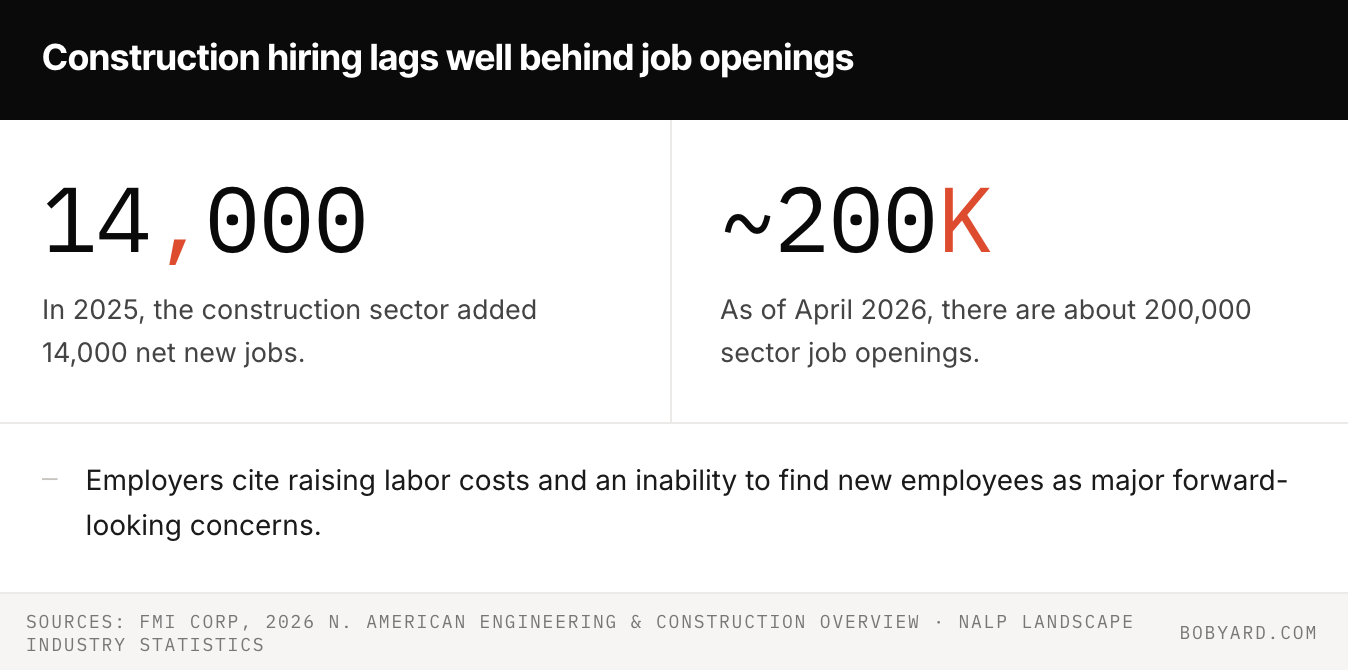
As companies grapple with this labor constraint, younger generations’ expectations about the workplace are shifting. Most students and early-career professionals use tools like Generative AI (GenAI) in their day-to-day lives and work routines. Younger generations have found that modern tools allow them to be more efficient and even creative, producing output they wouldn’t have been able to before the advent of LLMs and the like. Industries that do not offer similarly innovative tools will likely become less attractive to the next generation of workers.
(7) 2026 North American Engineering and Construction Overview: First Quarter | FMI Corp
(8) Construction sector job | Associated Builders and Contractors
(9) Landscape Industry Statistics | NALP
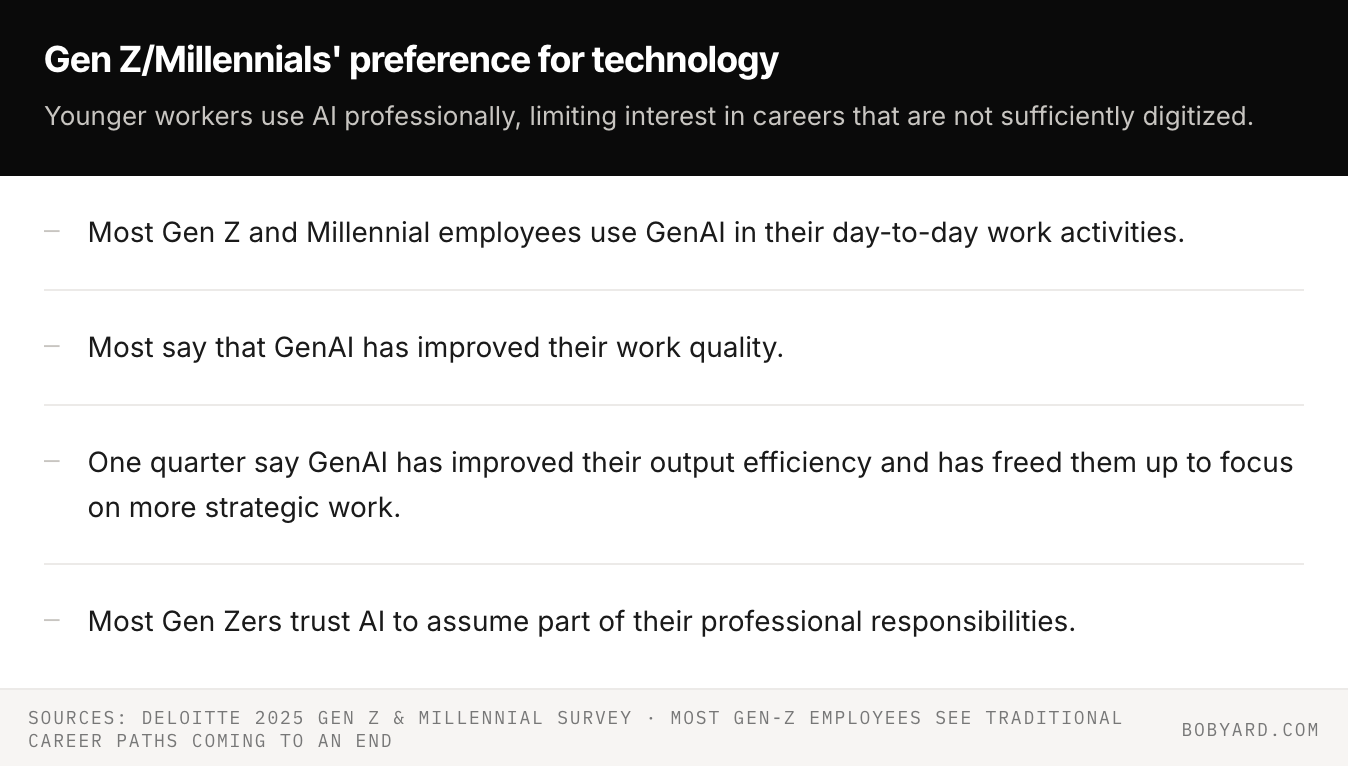
The path forward for landscaping employers cannot be simply to (re)train or upskill their current workforce. Landscaping companies must meet younger generations at their preference for technology-enabled careers and embrace modern tooling. Doing so requires identifying operational facets of the business where technology can increase output per worker without assuming a proportional increase in headcount.
In a labor-constrained environment, such as landscaping, the goal of new technology is to create leverage. A maximally leveraged employee spends most of their time on work that is:
Most other tasks, such as coordination, scheduling, estimating and other administrative work can and should be the purview of technology.
In other industries, organizations that have adopted AI, for example, the impact is clear. Those companies have realized better growth outcomes than peers that have not yet introduced similar tools. Early adopters have changed how employees apply their labor, by enabling them to redesign workflows or point AI toward growth and innovation-related objectives (12).
Landscaping has yet to identify the operational layer that technology can standardize, centralize and automate. For industry companies, the task will be not to simply digitize everything but to find where technology can create the most leverage. Answering that question—“Where do we apply technology to best augment labor?”—is the crux of whether the industry will be able to overcome the productivity paradox and attract new capital flows.
(12) The State of AI: Global Survey 2025 | McKinsey
It’s evident landscaping must innovate. Many firms cite labor constraints as the number one challenge to future growth (13). As long as the labor gap remains structural, and as long as companies struggle to further optimize output, the challenge may prove insurmountable. To push past this obstacle the industry should focus on maximizing leverage for the current employee base and assume they cannot hire their way out of the productivity paradox.
Capital markets claim they still haven’t identified high-frequency tasks worth automating in this industry, the solution may be hiding in plain sight. Project managers across the broader construction sector consider scheduling, logistics, and poor estimates to be the biggest barriers to hitting profitability goals. It is these types of fragmented, manual processes that may hold the answer to construction and landscaping’s productivity dilemma.
The next phase of landscaping innovation will come from isolating specific workflows that are difficult to standardize and even variable across jobs. These workflows are precisely what keep companies from realizing maximal leverage from their employees, because they happen often, are core to the business but carry a large administrative burden. Optimizing tasks with these characteristics can bring meaningful productivity gains to the industry.
The next paper in this series identifies a workflow that fits this description: estimating. Estimating sits at the confluence of pricing, coordination and revenue but isn't standardized and remains largely manual. It represents an operational layer that software can tackle and should be the focus of industry firms moving forward.
(13) Landscape Industry Statistics | NALP
(14) Project Management Survey Part 2 by Erda Estremera - Flipsnack
.png?width=1080&height=1080&name=Bloom%20Talent%20Solutions%20(1).png)